Lead asset · New Path Molecular

NPMR-047 / PDC-1

A fully synthetic phosphatidylserine-targeted drug conjugate carrying SN-38, in preclinical development for colorectal adenocarcinoma and pancreatic ductal adenocarcinoma.

Stage
Candidate Selection
Modality
Synthetic drug conjugate
Target
Phosphatidylserine (PS)
Payload
SN-38
Next milestone
CTA-enabling studies
Clinical status
Preclinical. Not approved.

NPMR-047 Asset Facts

A structured summary for investors, analysts and business development teams. Scientific content last reviewed: 28 July 2026. Development stage current as of: 28 July 2026.

Asset identifierNPMR-047
Alternative namePDC-1
ModalityFully synthetic phosphatidylserine-targeted drug conjugate
Target / biomarkerExternalised phosphatidylserine (PS) on tumour cell membrane and in tumour microenvironment
Targeting moietySynthetic PS-selective binding peptide
LinkerProprietary tumour-microenvironment-cleavable linker
PayloadSN-38, active metabolite of Irinotecan. Topoisomerase I inhibitor.
Lead indicationsColorectal adenocarcinoma; pancreatic ductal adenocarcinoma (PDAC)
Patient selectionGenetics-agnostic. NPMR-047 does not depend on a specific oncogenic mutation. Development-stage work is evaluating whether PS-expression characteristics can enrich for response.
Development stageCandidate Selection
Models testedMouse CDX models of colorectal adenocarcinoma and pancreatic ductal adenocarcinoma; colon cancer xenograft model
Route of administrationIntravenous
Patient selectionNMPR-047 does not depend on a particular oncogenic mutation. Development-stage translational work is evaluating whether PS expression or tumour microenvironment characteristics can enrich for response. Initial development is planned across unselected patients in the relevant indication.
Next milestoneDevelopment candidate nomination, followed by CTA-enabling studies: CMC/GMP manufacture, GLP toxicology, and regulatory package preparation
Target dateClinical Trial Authorisation targeted for 2028
Patent statusPatent application filed covering NPMR-047 drug conjugate series. Further details available under NDA.
Funding£800,000 Innovate UK / CRUK Biomedical Catalyst Grant (2025); £100,000 Innovate UK Feasibility Study Grant (2024)
Partnering statusSeeking £5M Series A to reach Clinical Trial Authorisation. Co-development and licensing discussions welcome.
Approved for clinical useNo. Investigational preclinical candidate only.

What the data show

Key findings from non-GLP exploratory efficacy and safety studies. All data are preclinical. Clinical safety and efficacy have not yet been established.
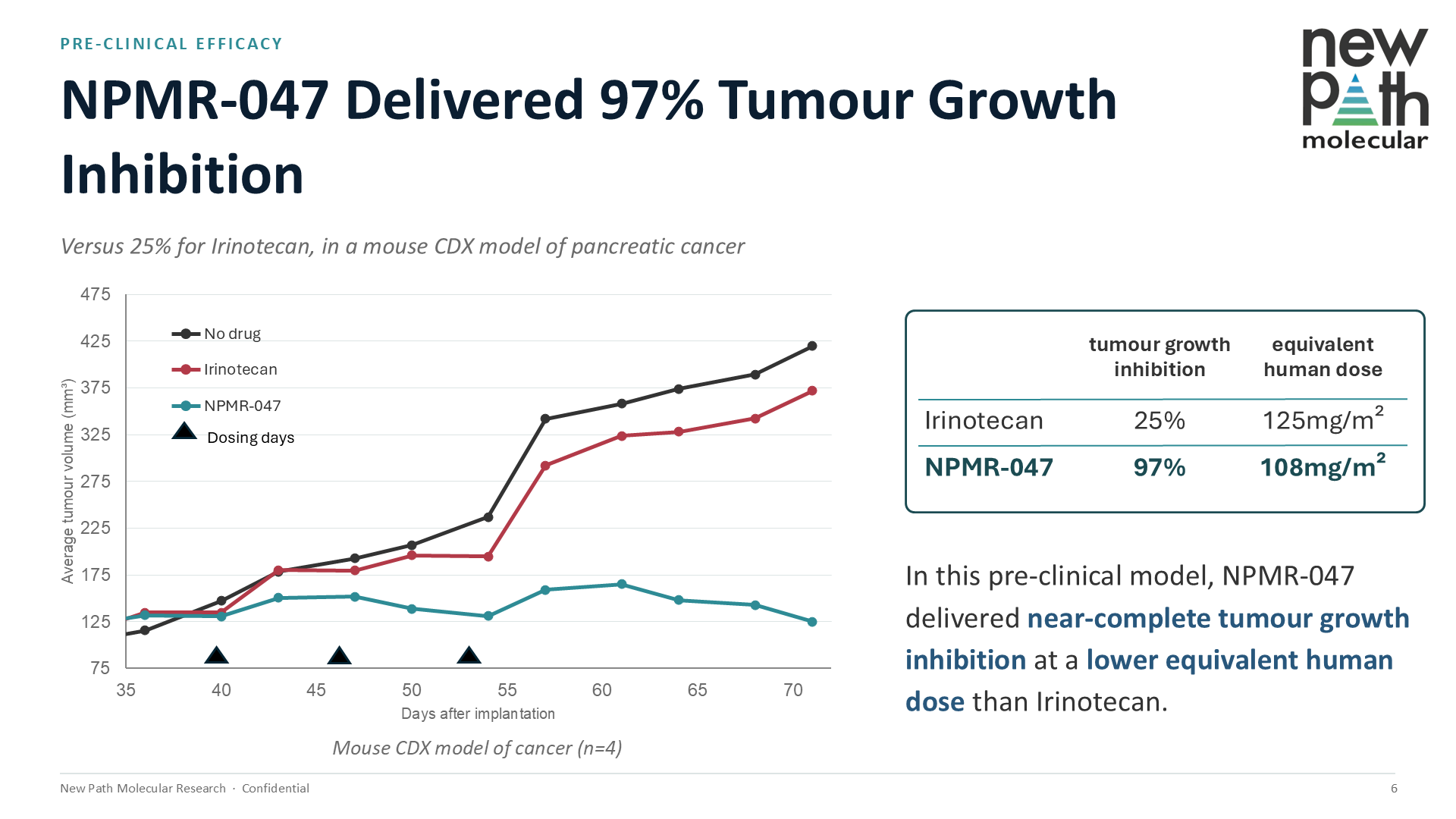
Line chart showing average tumour volume over days 35 to 71 after implantation. NMPR-047 line remains near baseline while Irinotecan and no-drug control lines rise steeply. Summary table shows 97% tumour growth inhibition for NMPR-047 versus 25% for Irinotecan at a lower equivalent human dose.
Efficacy · Mouse CDX model · Pancreatic cancer. NMPR-047 delivered 97% tumour growth inhibition versus 25% for Irinotecan, at a lower equivalent human dose (108 mg/m² versus 125 mg/m²). Non-GLP exploratory study, n=4.
Asset
NMPR-047
Comparator
Irinotecan (standard of care)
Model
Mouse CDX model of pancreatic ductal adenocarcinoma
Primary endpoint
Tumour growth inhibition (TGI)
Result — NMPR-047
97% TGI at 108 mg/m² equivalent human dose
Result — Irinotecan
25% TGI at 125 mg/m² equivalent human dose
Sample size
n=4
Study type
Non-GLP exploratory efficacy study
Clinical status
Preclinical. These results have not been replicated in humans.
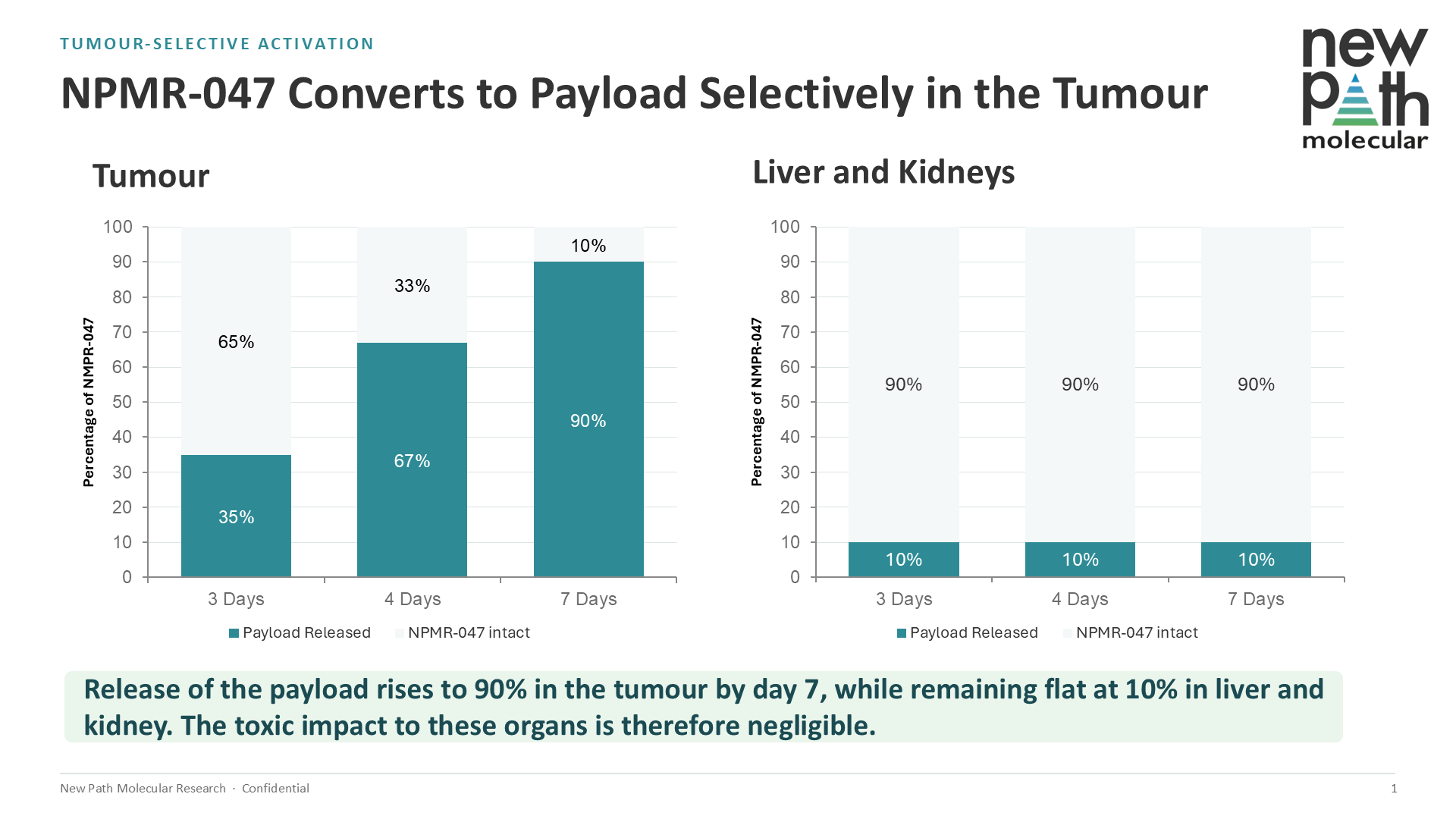
Two bar charts comparing payload release in tumour tissue versus liver and kidney at 3, 4 and 7 days after a single dose. Tumour bars rise from 35% to 90% released. Liver and kidney bars remain flat at 10% released throughout.
Tumour-selective activation. Payload release rises to 90% in tumour tissue by day 7 following a single dose, while remaining at 10% in liver and kidney throughout. Non-GLP exploratory pharmacokinetic study.
Asset
NMPR-047
Measurement
SN-38 payload release as percentage of total NMPR-047 in tissue
Tumour — day 3
35% released
Tumour — day 4
67% released
Tumour — day 7
90% released
Liver and kidney
Approximately 10% released at all time points
Administration
Single dose, intravenous
Study type
Non-GLP exploratory pharmacokinetic study
Clinical status
Preclinical. These results have not been replicated in humans.
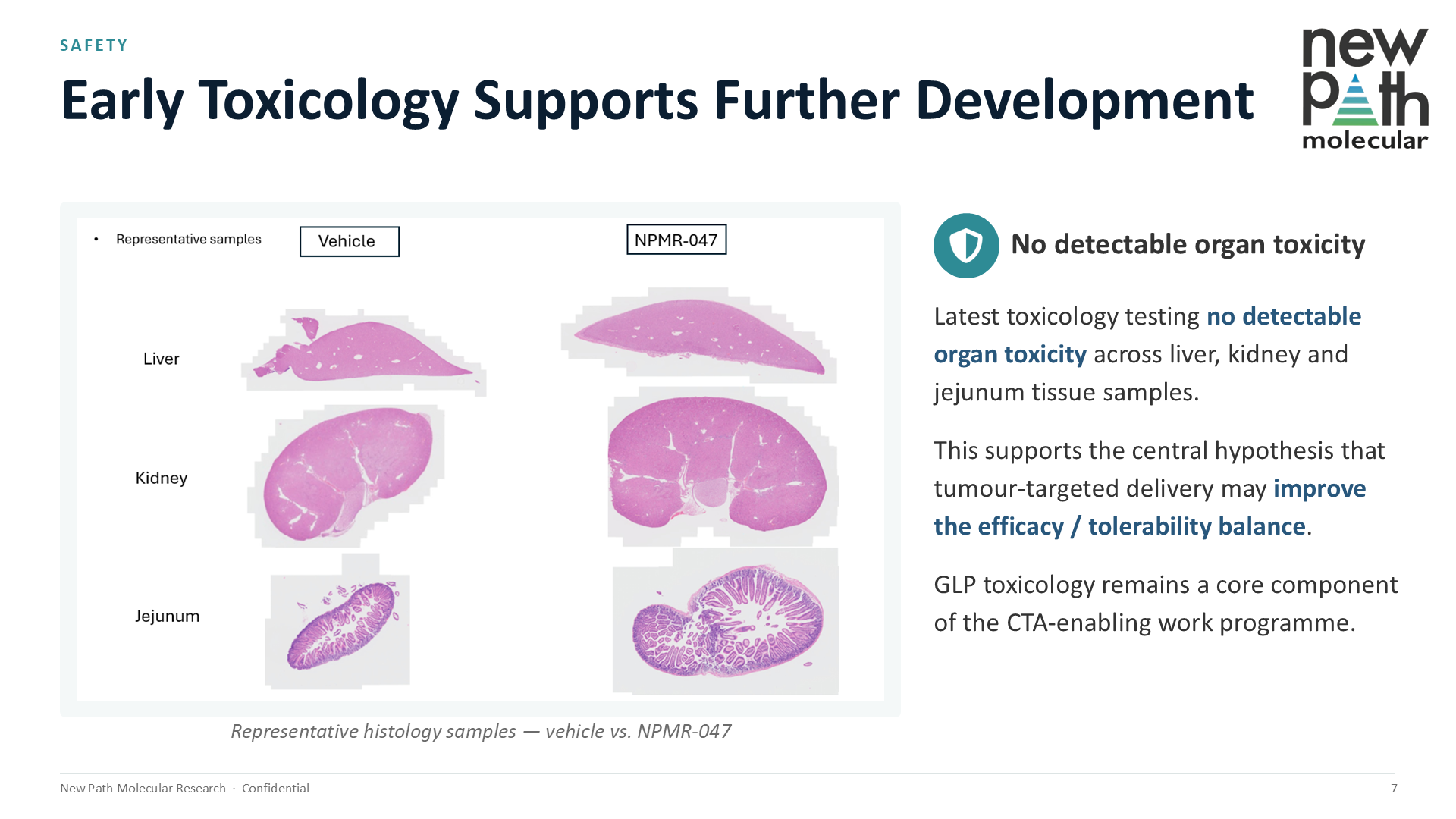
Six histology images comparing vehicle control versus NMPR-047-treated tissue samples from liver, kidney and jejunum. No visible morphological differences between the two groups.
Safety · Histopathology. Representative histology samples show no treatment-related changes in liver, kidney or jejunum tissue versus vehicle control. Non-GLP exploratory study. GLP toxicology is planned as part of the CTA-enabling programme.
Asset
NMPR-047
Comparator
Vehicle control
Tissues assessed
Liver, kidney, jejunum
Method
Histopathological assessment of representative tissue sections
Finding
No treatment-related histopathological changes detected in any assessed tissue
Study type
Non-GLP exploratory safety study
Remaining work
GLP toxicology, formal safety pharmacology and biodistribution studies are planned as part of the CTA-enabling programme and have not yet been completed
Clinical status
Preclinical. These results have not been replicated in humans.
Preclinical data only. All findings are from non-GLP exploratory studies in mouse models. Clinical safety and efficacy in humans have not yet been established. GLP toxicology, formal safety pharmacology and clinical translation studies are planned as part of the CTA-enabling programme.

How we are reducing development risk

A frank summary of what has been established in preclinical studies and what remains to be completed before clinical entry.

Biology de-risking
PS exposure established in relevant tumour models
PS-binder selectivity demonstrated
Efficacy reproduced in colorectal and pancreatic models
Tumour accumulation confirmed. Payload detected more than 7 days post-dose.
Remaining: broader human-tissue validation and translational PK/PD
Molecule de-risking
Fully synthetic, defined composition
Established SN-38 payload with a known clinical record
Tumour-associated linker cleavage strategy confirmed
PS biomarker already FDA-cleared for clinical trial use
Remaining: candidate nomination, full PK/PD, biodistribution and GLP toxicology
CMC de-risking
Commercially available starting materials
Convergent chemical synthesis. No cell lines or fermentation required.
No cold chain or antibody manufacturing required
Supported by £900k non-dilutive funding before investor capital is deployed
Remaining: process development, analytical methods, formulation and GMP transfer

Path to Clinical Trial Authorisation

£5M funds the next value inflection: reaching CTA with NPMR-047.

Now
Current stage
Candidate Selection
NPMR-047 is the designated lead asset. Preclinical efficacy established in two tumour models. Early safety data are supportive. Patent application filed.
2026 to 2027
CMC / GMP
Clinical-grade manufacturing
Process development, analytical methods, formulation and GMP transfer to enable clinical-grade supply of NPMR-047.
2027
Safety
GLP toxicology package
Formal GLP safety pharmacology and toxicology studies in two animal species to support the CTA submission.
2028
Regulatory
CTA preparation and submission
Compilation and submission of the Clinical Trial Authorisation package to the UK MHRA, targeted for H1 2028.
2028 to 2029
Clinical
Phase 1/2a readiness
First-in-human Phase 1/2a trial preparation. Two potential licensing points: post-CTA and post-human proof of concept.
Get in touch

Interested in NPMR-047?

Contact us for diligence materials, partnering discussions or investor information.

Contact the team

Development stage and content history

This page is updated when the development stage, key data, or funding status changes. Scientific content last reviewed: 28 July 2026. Development stage current as of: 28 July 2026.

Date Update
July 2026 Asset at candidate selection stage. In vivo efficacy and safety data presented publicly for the first time at BioBabraham Symposium.
June 2025 £800,000 Innovate UK Biomedical Catalyst Grant awarded to advance NMPR-047 towards IND/CTA-enabling studies.
July 2024 Lead optimisation phase funded. Programme advancing through candidate selection.
June 2023 Selected for Cancer Research Horizons / Innovate UK Oncology Accelerator programme.